Insights
SaaS: The Key to Digital Transformation for Small and Medium Enterprises in Taiwan
5 mins read
📜Prologue
Twilio CEO Jeff Lawson said, "Cloud computing has given us a new business model and disruptive operational methods; we now have more tools, knowledge, and connections than at any time in human history, and this is just the beginning."
"Software" and "the internet" built the internet, which in turn reshaped the software industry; "cloud computing" is reconstructing the software ecosystem; the "SaaS business model" serves as a catalyst; we witness that "software" is devouring the whole world.
The Digital Transformation Path of SMEs: An Indispensable SaaS Platform
With technological advancements and intensifying market competition, digital transformation has become an essential path for business development. According to statistics, small and medium-sized enterprises (SMEs) account for more than 98% of all businesses in Taiwan and make up over 80% of the total employment in the country. This indicates that SMEs are a key pillar of Taiwan's economy and social stability and are also the main driving force behind economic development in Taiwan. Although as high as 91% of SMEs have started to invest in digital transformation, their integration depth and coverage are still far from that of large enterprises. Facing the challenges of limited resources, merely transforming with the goal of reducing costs is no longer sufficient for them to stand out in the market. Only by changing their mindset and focusing on expanding market share and further optimizing customer experience can they truly achieve sustained revenue growth. Therefore, how to achieve digital transformation is a pressing issue that every SME needs to address.
In the context of limited resources, the SaaS model may be a powerful lever for SMEs on the path of digital transformation. By collaborating with SaaS vendors, SMEs do not need to build large systems themselves; they only need to pay as they go to enjoy stable and reliable subscription services. The subscription model not only helps SMEs achieve financial predictability and reduce business risks but also supports SaaS vendors in continuously optimizing innovation and improving service quality, creating more digital transformation value for businesses. At the same time, SMEs can fully leverage the advantages of SaaS vendors' technology, data analysis, and more to quickly optimize and upgrade their business processes. Although the application of SaaS among SMEs is not yet widespread, with the rising awareness of digital transformation and the B2B service experience accumulated in Taiwan, SMEs should be able to build competitive advantages by connecting regional resources through SaaS.
SaaS: The Secret Weapon for SMEs' Counterattack
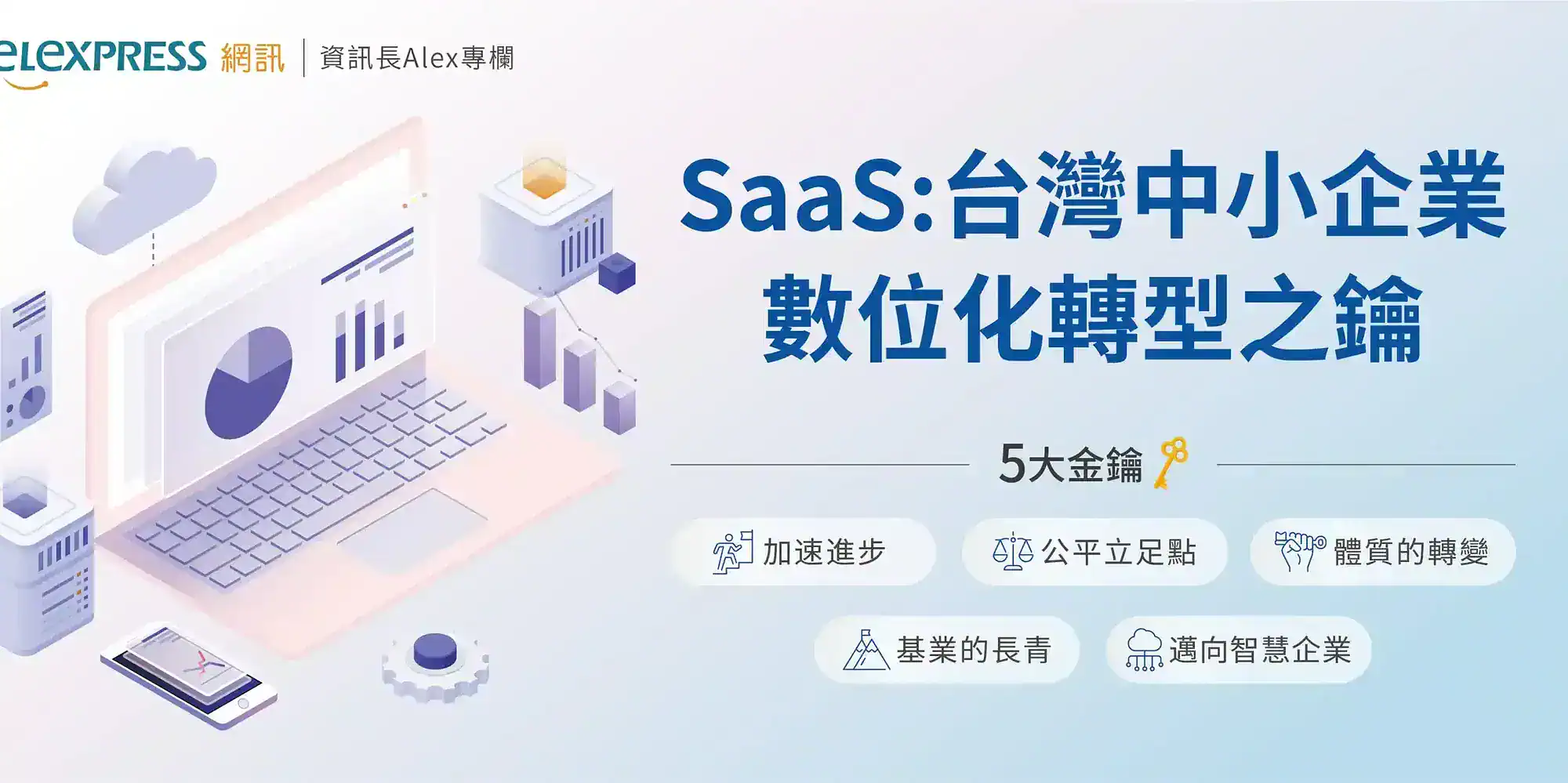
Specifically, SaaS has the following five significant advantages in supporting SMEs' digital transformation:
1. Accelerated Progress: With the rapid development of technology, greater bandwidth, more data, more convenient API connections, and more powerful and intelligent AI innovative applications have provided SaaS providers with a brand new development environment in the field of enterprise application software. This has attracted more SaaS providers to participate, accelerating the development, competition, learning, and collaboration of the SaaS business model and ecosystem, igniting innovation. Everyone works together to grow the market, allowing business customers to have more choices, thus accelerating the digital transformation of the entire industry.
2. A Level Playing Field: SaaS services provide equal opportunities, regardless of whether one is an individual entrepreneur, a small to medium-sized enterprise, or a Fortune 500 company. They have the opportunity to choose the same top-tier SaaS application services on certain business processes, learn best practices, effectively bridging the digital divide, and aiding digital transformation. This equality also encourages learning, competition, and cooperation among companies of different sizes. In the SaaS business model, every user is "equal"!
3. Transformation of Structure: The subscription model of SaaS brings stable and periodic financial forecasts for businesses while lowering risks. For subscription services to be successful, it is crucial to get closer to and understand user needs, comprehend business processes, and continually create new value. SaaS providers must prioritize customers and continuously create value, enhance customer satisfaction, and optimize products and services, allowing both SaaS providers and business clients to enter a virtuous management cycle and future development, completing the practice of CRM.
4. Longevity of Business: The flexibility of SaaS services significantly reduces the initial project setup costs and switching costs between different SaaS application services. This flexibility allows business users to boldly try diverse application services, thus growing in the process of trial and error. Changing the traditional mindset of "one trial determines lifetime" and fear of making mistakes helps achieve long-term revenue growth. Quick implementation, instant differentiation is better than waiting; immediate iteration. Planning, trialing, changing, and starting again. The process of repeated trial and error refines needs to be clearer and goals more defined.
5. Moving Towards Intelligent Enterprises: SaaS services help enterprises not only save the substantial installation and maintenance costs of traditional on-premise application software systems but also enhance the security, scalability, accessibility, compliance, usability, and future development of application services after transitioning to the cloud. Improving team work efficiency accelerates painless transformation for businesses, entering a positive development cycle, and becoming intelligent enterprises that embody high flexibility, agility, and resilience.
Tips for SME Management
From PSF (problem-solution fit), to PMF (product-market fit), and then to BMMF (business model-market fit), the continuous pursuit of "Fit" emphasizes maximizing professionalism and making profits secondary, honing skills to the utmost degree, attracting loyal customers automatically. Over the course of time, it becomes evident that those who earn slowly, because they do not chase short-term profit objectives, ultimately earn more.
SaaS Illuminating SMEs: New Opportunities for Digital Transformation
In summary, the SaaS business model provides an excellent entry path for capital and talent-lacking SMEs to digitalization. With the continuous development of the SaaS ecosystem, the road for SMEs' digital transformation will become smoother.
However, simply introducing SaaS will not solve all problems. Enterprises need to choose experienced SaaS service providers based on their own needs to enjoy the latest and best service experience, freeing themselves from the hassle or obsession of handling everything by themselves; thereby saving both manpower and resources, managing timelines effectively, and leveraging the advantages of cloud and SaaS services to focus on the digital transformation process, continuously improving the company's competitiveness.
Furthermore, SMEs also need to cultivate digital talent, establish technical teams, and maintain close communication with SaaS suppliers, achieving deep integration through APIs or other feasible methods, to maximize the potential of SaaS and navigate steadily in the digital wave. It is believed that as the SaaS ecosystem continues to grow, the digital transformation path of Taiwanese SMEs will become increasingly unobstructed.
You might also like



Let's evaluate your customer service upgrade path.
Talk to us about your industry scenario, and we will provide you with the best AI × human collaboration suggestions.